Sourcing Intake Playbook
Convert an informal business request into a scoped, reviewable sourcing effort.
Primary output: Scoped sourcing request and readiness checklist
View playbookStrategic sourcing field guide
Expert-built templates and practical toolkits for category strategy, supply-market analysis, supplier discovery, should-cost review, shortlist planning, and sourcing-event readiness.
A buyer-side sourcing playbook provides a repeatable framework for moving from sourcing intake and market intelligence through supplier discovery, cost analysis, shortlisting, and sourcing-event readiness.
A sourcing playbook is a repeatable buyer-side framework that helps teams make consistent decisions before and during a sourcing event. It connects the questions to ask, evidence to gather, outputs to prepare, and people who need to review the findings.
The work may include sourcing intake, category strategy, supply market analysis, supplier discovery, cost and TCO analysis, supplier shortlisting, and event readiness. Each stage should clarify what is known, what remains an assumption, and what must be resolved before the next decision.
The purpose is better sourcing decisions, not simply producing documents. Teams can use the playbook library for a particular stage or explore the full sourcing playbook system to connect the stages into a reviewable sourcing packet.
The sourcing problem
Teams are asked to find suppliers, compare options, or prepare events before scope, evidence, cost drivers, owners, and assumptions are visible. These playbooks create a repeatable way to gather the right inputs before formal bidding, contracting, renewal, or vendor management.
These playbooks concentrate on the work required before formal bidding, contracting, renewal, and vendor management: category strategy, supply-market intelligence, supplier discovery, cost drivers, shortlist planning, and event readiness.
AI-assisted preparation
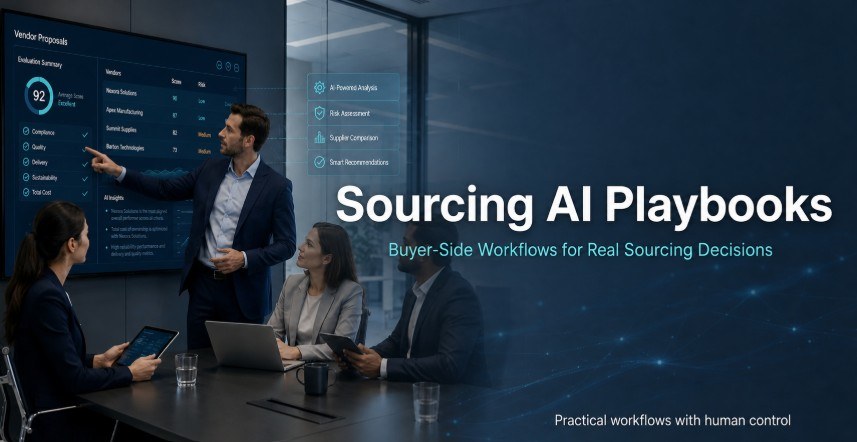
The playbooks help teams use AI-supported drafting, synthesis, and comparison while keeping source notes, assumptions, owner review, and approval gates visible.
Workflow model
The workflow creates a sourcing packet that can be reviewed by sourcing, business, finance, legal, compliance, or technical owners before later decisions are made.
Clarify the need, scope, owners, timing, constraints, and source material.
Turn demand, current state, requirements, and assumptions into sourcing context.
Map supplier segments, source evidence, market pressure, and open questions.
Build a supplier universe with fit signals, evidence gaps, and constraints.
Separate cost-driver facts, assumptions, TCO inputs, and sensitivity questions.
Document shortlist logic before formal scoring or vendor selection.
Confirm the sourcing packet is ready for the next phase.
Featured playbooks
Each playbook produces a practical artifact: a checklist, worksheet, matrix, assumption log, decision gate, or sourcing summary.
Convert an informal business request into a scoped, reviewable sourcing effort.
Primary output: Scoped sourcing request and readiness checklist
View playbookTranslate demand, current state, requirements, assumptions, and constraints into a practical category sourcing strategy.
Primary output: Category strategy profile and sourcing question
View playbookStructure supply-market research so sourcing teams can compare market options, supplier segments, constraints, and evidence quality.
Primary output: Supply market scan and evidence log
View playbookCreate a structured supplier universe before shortlist planning or formal evaluation.
Primary output: Supplier universe with fit signals and evidence gaps
View playbookSeparate cost-driver facts, assumptions, total-cost inputs, and sensitivity questions before comparison or negotiation.
Primary output: Cost-driver and TCO assumption log
View playbookDocument why suppliers should be advanced, held, removed, or reviewed before formal evaluation begins.
Primary output: Shortlist rationale and review grid
View playbookStarter kit
The completed version shows how the worksheets connect across a realistic business-side sourcing example. The blank version gives teams a clean starting point.
Workbook examples
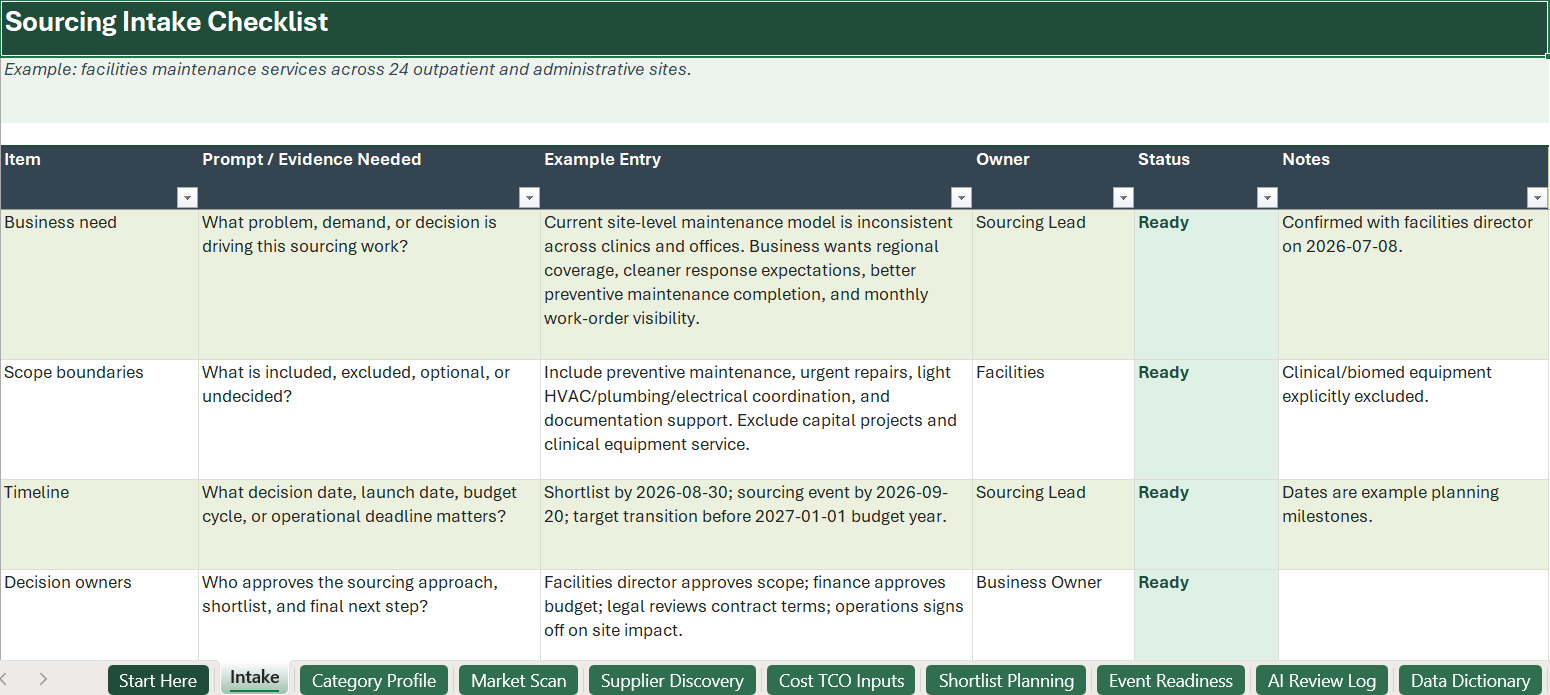
Real workbook screenshots show the fields, review columns, and connected tabs included in the starter kit.
Enlarge preview
Clarifies: Business need, scope boundaries, timing, decision owners, known constraints, source material, and readiness gates.
Supports: Whether the request is ready for market scan and supplier discovery.
Useful fields: Owner, status, notes, evidence prompts, and example entries make it a reviewable sourcing packet rather than a blank form.
Enlarge preview
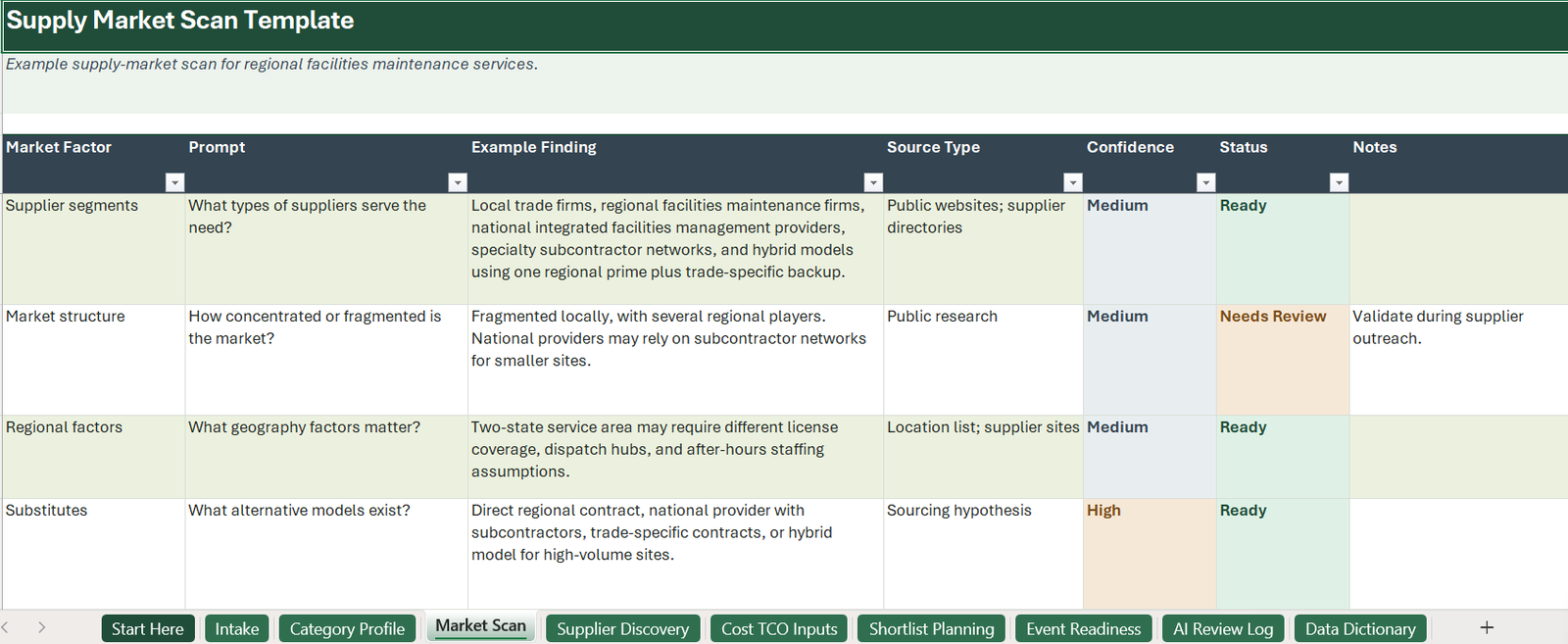
Clarifies: Supplier segments, market structure, regional factors, substitutes, capacity signals, cost pressure, and evidence quality.
Supports: Whether the team has enough market intelligence before supplier outreach.
Useful fields: Source type, confidence, status, and notes help separate observed evidence from assumptions.
 Enlarge preview
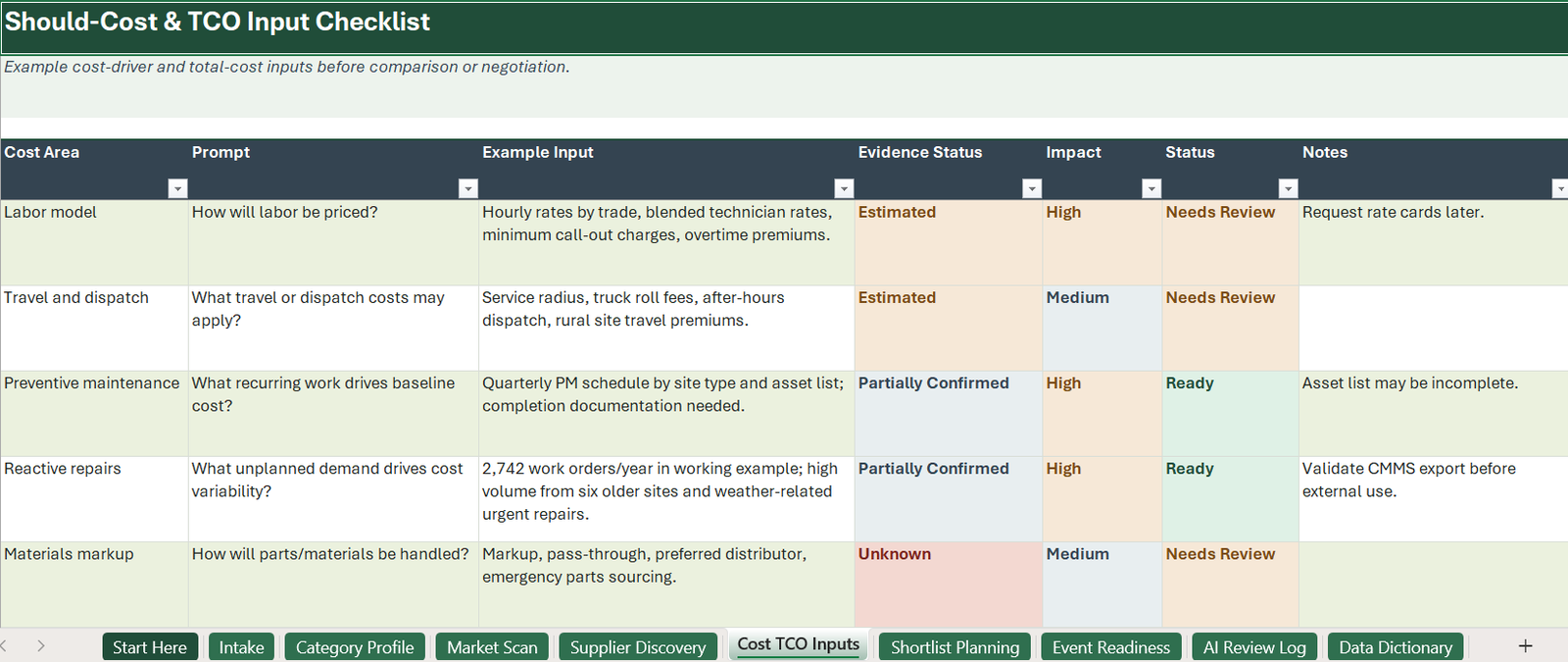
Clarifies: Labor model, travel and dispatch, preventive maintenance, reactive repairs, materials markup, reporting, and switching friction.
Supports: Whether cost-driver assumptions are ready for finance review before shortlist approval.
Useful fields: Evidence status, impact, readiness, and notes show which costs are known, estimated, or still unresolved.
What makes these different
These are not isolated prompt sheets. The artifacts are designed to support sourcing governance and reviewer handoff.
Built around sourcing teams, category owners, finance partners, and business stakeholders preparing supplier decisions.
Fields for source notes, confidence, evidence gaps, assumptions, and status help prevent unsupported claims from becoming decisions.
Owners, decision gates, and human approval checkpoints keep judgment with people rather than automated outputs.
Human-controlled AI
AI may assist with research synthesis, source comparison, drafting, and checklist preparation. People retain sourcing judgment, supplier decisions, legal review, compliance determinations, and business approvals.
About the methodology
The methodology emphasizes source-based evidence, visible assumptions, editable artifacts, and reviewer accountability. Learn how the playbooks are maintained and how to request licensing or adaptation.
Next step
For the broader lifecycle, explore our strategic sourcing resources. The free kit shows the workflow. The full package discussion can cover team use, advisory use, category-specific adaptations, and implementation support.